Norway taxed the rich, some millionaires left — did it backfire?
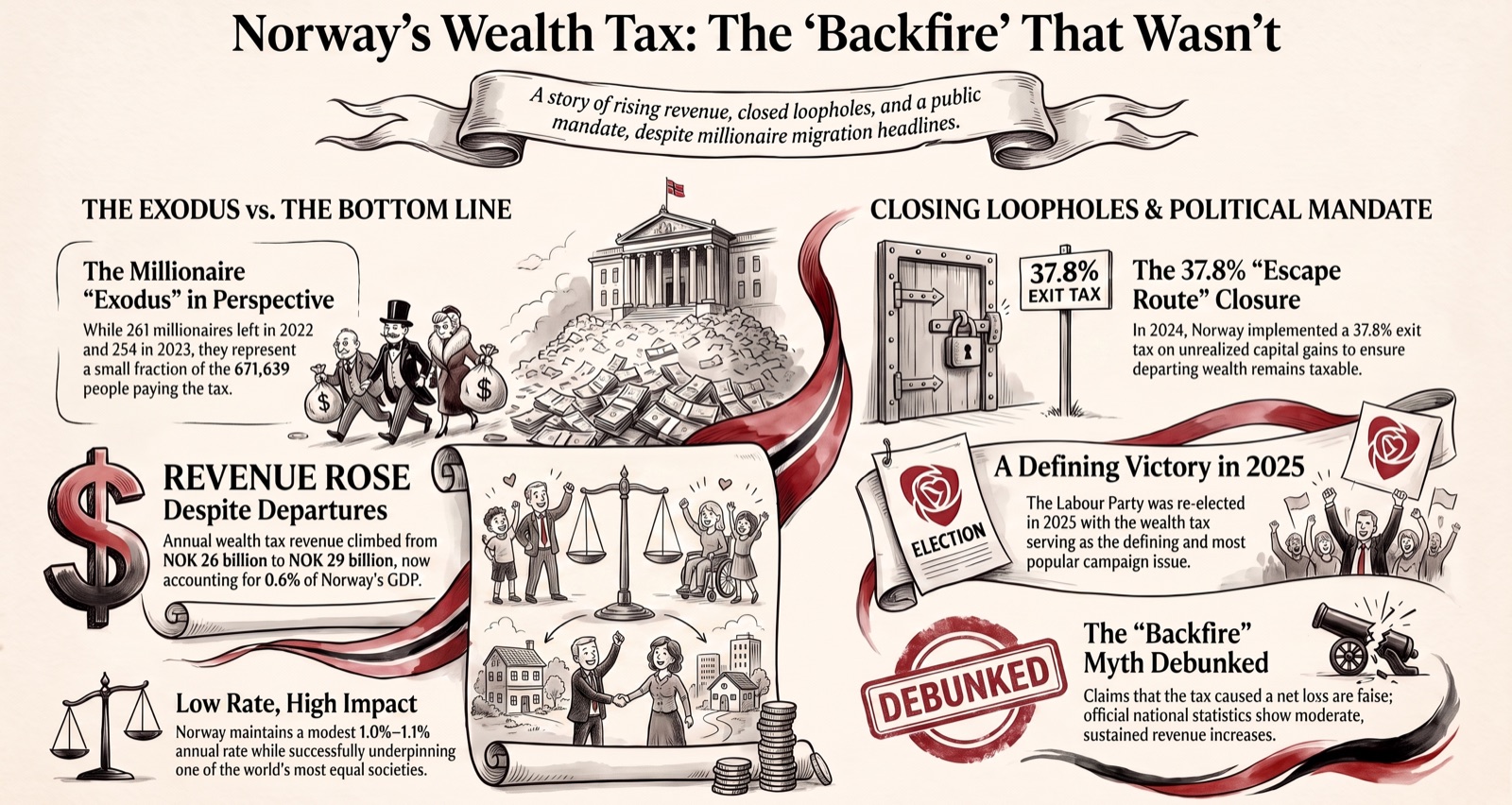
No. Some wealthy Norwegians did leave after the 2022 increase — but wealth tax revenue ROSE from NOK 26bn to NOK 29bn between 2022 and 2023 and now brings in about 0.6% of GDP a year. A 37.8% exit tax on unrealised gains closed the escape route in 2024, and Norwegians re-elected the government that raised the tax.
Norway is the test case everyone cites and almost everyone gets wrong. The country has taxed wealth since 1892. In 2022 the Labour government raised the top rate to 1.1% on net wealth above roughly £1.5 million, and a much-shared story followed: the millionaires fled, and the tax 'lost more than it raised'. The first half is true. The second half is false.
The exodus was real but small. Data from the conservative think-tank Civita shows 261 residents with assets above 10 million crowns left in 2022 and 254 in 2023 — roughly double the pre-hike rate, out of about 670,000 people who pay the tax. Meanwhile the official numbers from Statistics Norway show wealth tax revenue rising from NOK 26 billion in 2022 to NOK 29 billion in 2023, and Reuters reports it now brings in about 0.6% of GDP every year — real money, comparable to the fiscal gaps Britain agonises over. The viral 'net loss' figures come from projections by relocation advisers, not from official statistics.
Norway then closed the door the leavers used: since 2024, emigrating triggers a 37.8% exit tax on unrealised capital gains above 3 million crowns, and the loopholes that let emigrants defer it indefinitely are gone. And in September 2025 Norwegians were given a referendum on the policy in all but name — the wealth tax was the defining issue of the election — and returned the Labour government that raised it. Research from Statistics Norway finds the burden falls overwhelmingly on the richest and that business owners have the liquidity to pay; the NBER's study of wealth-tax migration finds the aggregate economic effect of leavers is small.
The honest reading is not that the tax is costless — around 40% of the emigrants are business owners, and critics argue it chills domestic investment. Norway pays a real price in departed founders. But the deal it got in exchange is the one the viral version hides: the revenue went up, the society stayed one of the world's most equal, and the voters, given the chance, chose to keep it. Reuters' own summary is the one-line rebuttal: a wealth tax will scare off some millionaires — and it can still be worth it.
“The takeaway: a wealth tax will scare off some millionaires, but if set broadly enough, revenues can still be worth it.”— Reuters, reporting from Oslo, November 2025, read the report
Common questions
- Didn't Norway lose $594 million from the tax rise?
- That figure comes from estimates circulated by wealth-relocation advisers and went viral on social media. Official Statistics Norway data shows wealth tax revenue rose from NOK 26bn (2022) to NOK 29bn (2023). Even accounts sympathetic to the leavers concede the revenue picture is nothing like the viral version.
- How many rich people actually left?
- About 261 in 2022 and 254 in 2023 with assets over 10 million crowns, per Civita — double the previous rate, but a tiny fraction of the ~670,000 Norwegians who pay the tax. Of Norway's 400 richest, 105 now live abroad or have moved wealth to relatives who do.
- What stops the rest leaving?
- Since 2024, leaving Norway triggers an exit tax of 37.8% on unrealised capital gains above 3 million crowns, with the indefinite-deferral loophole closed. You can go, but the gains you built under Norway's protection get taxed on the way out.
- Do Norwegians support it?
- The wealth tax was the defining issue of the September 2025 election, which the Labour Party that raised it won. Polling just before the vote found 39% wanted the tax kept or raised versus 28% wanting abolition.
Sources — check them yourself
- Norway's lesson for Europe on wealth taxes: let some millionaires go Reuters
- A wealth tax at work (Discussion Paper 960) Statistics Norway
- Taxing top wealth: migration responses and their aggregate economic implications NBER Working Paper 32153
- The 2025 Norwegian election West European Politics (Taylor & Francis)