Has anywhere actually voted to tax the rich — and gone through with it?
Yes. In May 2026, New York state lawmakers passed Mayor Zohran Mamdani's pied-à-terre tax — an annual levy on high-value second homes in the city, expected to raise around $500 million a year. His larger plan, a 2% income tax on earnings over $1 million, is still being fought over in Albany.
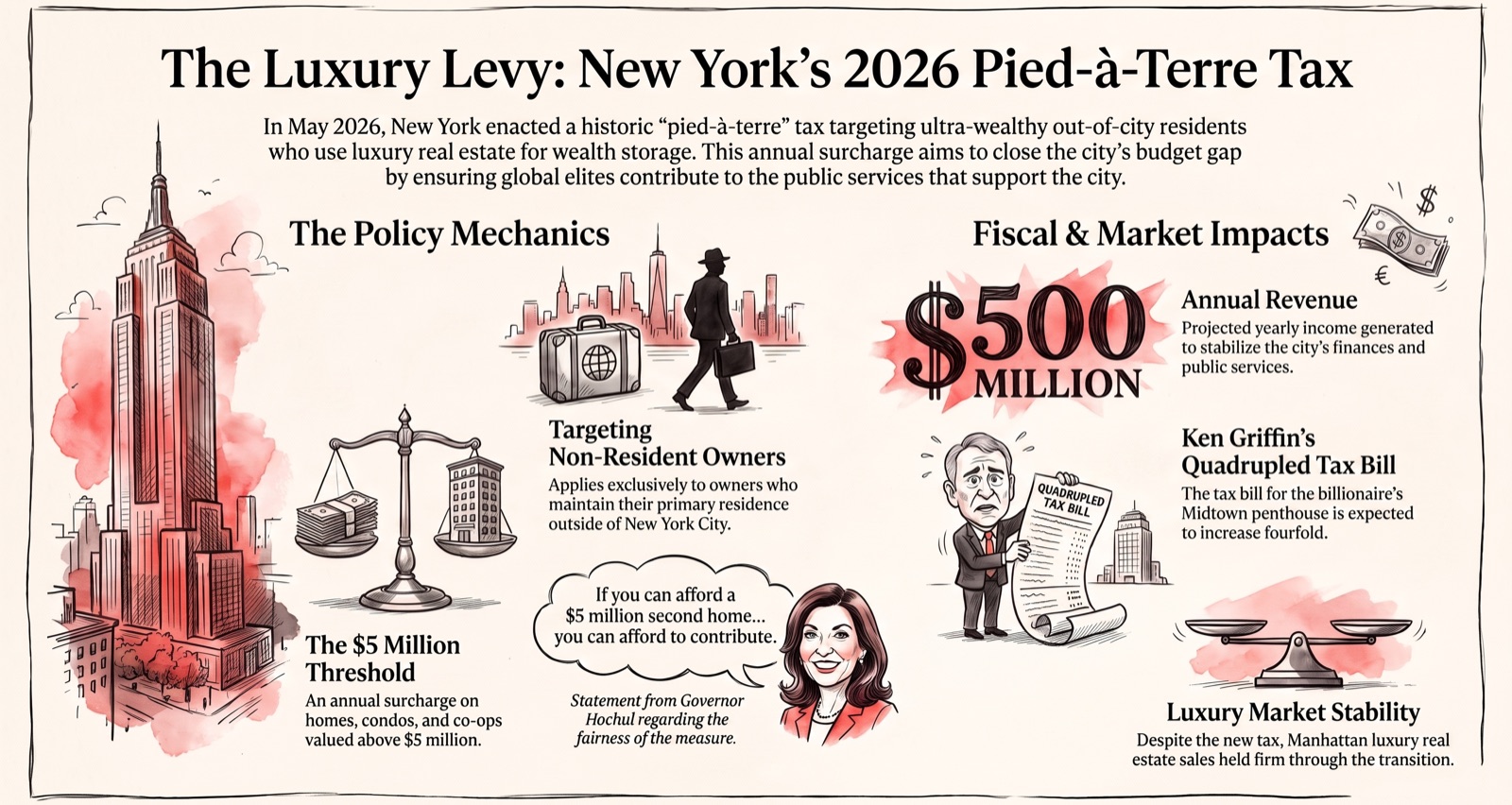
Zohran Mamdani won the New York mayoralty campaigning explicitly on taxing the rich, took office in January 2026 facing a historic $12 billion budget gap, and within five months had his first wealth-targeting tax through the state legislature. The pied-à-terre tax, passed by Albany lawmakers in May 2026, is an annual levy on high-value second homes in New York City — properties owned by people whose primary residence is somewhere else.
The design is deliberately targeted. It touches nobody's primary home. In its first phase it applies to non-primary condos and co-ops assessed at over $1 million, at rates from 4% to 6.5% of assessed value; from 2028 the city moves to market-based valuations with rates of 0.8% to 1.3% on properties worth over $5 million. It is expected to raise around $500 million a year for a city budget that funds schools, transit and housing.
The predictable threats followed. Citadel CEO Ken Griffin — whose $238 million Central Park penthouse had been taxed on a city valuation of just $15.5 million — became the public face of opposition after Mamdani announced the tax in a video outside his building, and threatened to move jobs to Miami. Griffin's Manhattan property tax bill roughly quadruples to around $4 million a year. Yet by July 2026, CNBC reported that Manhattan luxury real-estate sales were holding firm despite fears of a 'Mamdani effect'.
This page matters for Britain because it breaks the fatalism. The standard argument against taxing wealth is that no one dares and it can't be done. New York — the world's densest concentration of financial wealth — just did it, through the ordinary democratic process, and the sky has not fallen. The bigger test, Mamdani's proposed 2% income tax on New Yorkers earning over $1 million, is still being fought in Albany. But the first domino has actually fallen.
Common questions
- Did this actually pass, or is it just a proposal?
- It passed. Mamdani and Governor Hochul announced the proposal in April 2026, and state lawmakers passed it in late May 2026. CNBC published a breakdown of who pays and how much on 28 May 2026.
- Doesn't this just hit ordinary people with a second flat?
- No. It applies only to non-primary residences above a $1 million assessed value in phase one, and above a $5 million market value once revaluation kicks in from 2028 — luxury pieds-à-terre, most of them owned by people who do not pay New York income tax because they live elsewhere.
- Did the rich flee New York?
- Not so far. CNBC reported in July 2026 that Manhattan luxury property sales held firm despite predictions of a 'Mamdani effect'. Ken Griffin — the loudest objector — was already a tax resident of Florida before the tax existed.
- What about his bigger tax-the-rich plan?
- Mamdani's flagship proposal — a 2% city income tax on earnings above $1 million — needs approval from the state legislature in Albany, and that fight is ongoing. The pied-à-terre tax was the first, fastest win.
Sources — check them yourself
- New York passes Mamdani's pied-à-terre tax. Here's who pays and how much CNBC
- Mayor Mamdani, Governor Hochul announce state's first pied-à-terre tax proposal NYC Mayor's Office
- Manhattan luxury real estate sales hold firm despite fears of a 'Mamdani effect' CNBC
- Mamdani eyes tax-the-rich push as NYC budget gap looms New York Focus