Are the official statistics on UK wealth inequality even accurate?
No — they understate it. In June 2025 the Office for Statistics Regulation suspended the official accreditation of the ONS Wealth and Assets Survey over data quality concerns, and the survey has long been known to miss the ultra-rich, so the true wealth gap is almost certainly larger than the official numbers show.
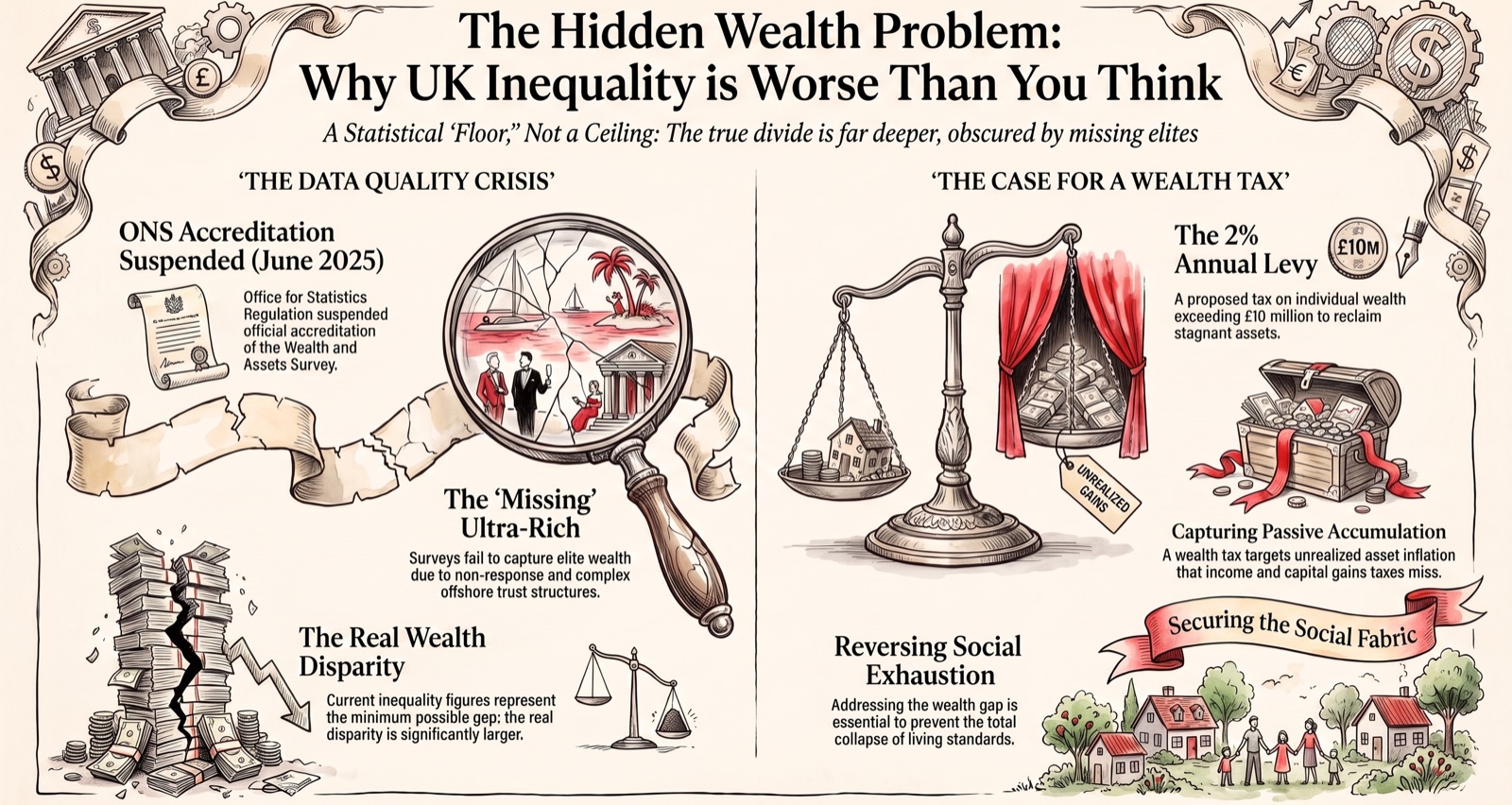
Every statistic on this site draws on official or academic wealth data, and it is worth being honest about what that data can and cannot see. The main instrument, the ONS Wealth and Assets Survey, has known limitations at the very top of the distribution — and in June 2025 the Office for Statistics Regulation, the UK's independent statistics watchdog, suspended its accreditation as official statistics following quality concerns.
The problem is structural. Wealth surveys rely on people answering questions about what they own. The ultra-wealthy are far less likely to respond at all, and when they do, complex holdings — offshore structures, trusts, private business stakes — are the hardest assets to capture. A survey built on voluntary self-reporting is weakest precisely where wealth is most concentrated.
Researchers at the Institute for Fiscal Studies have shown that even methodological choices within the data, such as how defined benefit pensions are valued, substantially change the measured shape of the wealth distribution. The picture is sensitive to assumptions in a way that income statistics, drawn largely from tax records, are not.
The implication cuts one way. If the measurement misses wealth at the top, then the figures across this site — the 1% owning more than the bottom 70%, the 456x gap — are conservative. The real concentration of wealth in Britain is not smaller than the official statistics suggest. It is larger, by an amount nobody can currently measure. That is itself part of the case for taking wealth seriously as a policy object: you cannot tax what you refuse to count.
“At the moment we don't even know how much they're worth — we're not measuring it — and we have no capacity to tax them, because they can very easily avoid income taxes.”— Gary Stevenson, Channel 4 News interview
Common questions
- Why did the official UK wealth survey lose its accreditation?
- In June 2025 the Office for Statistics Regulation suspended the Wealth and Assets Survey's accreditation as official statistics after quality concerns were identified, supporting a request from the ONS itself. The suspension applies to round 8 of the survey and onwards while the ONS reviews its methods.
- Does bad data mean inequality might actually be lower than reported?
- The known biases run the other way. The survey's weakness is capturing the very top — non-response by the wealthy and assets hidden in offshore structures and trusts. Correcting for that would raise measured inequality, not lower it.
- So can any number on this site be trusted?
- The figures here are the best available estimates from the ONS, academic researchers and NGOs, and each page links its primary sources. The point of this page is that where those numbers err, they err on the side of understating the wealth gap.
- Is anyone trying to fix the measurement?
- The ONS is reviewing the survey and reporting progress to the regulator, and researchers such as the IFS have published methods for reassessing parts of the distribution. Until that work lands, the top tail of British wealth remains officially unmeasured.
Sources — check them yourself
- Statistics from the Wealth and Assets Survey (accreditation suspension) Office for Statistics Regulation
- ONS letter to the OSR on the accreditation of Household Total Wealth in Great Britain ONS
- How is wealth distributed across British households? Reassessing the valuation of pensions Institute for Fiscal Studies
- Household total wealth in Great Britain: quality and methods guide ONS