Do working people really pay 50% tax while billionaires pay close to nothing?
A higher-rate employee pays 40% income tax plus 8% National Insurance, a combined rate above 48%, while a billionaire whose wealth grows through rising asset prices can borrow against those assets, spend the loan, and never trigger a tax bill at all.
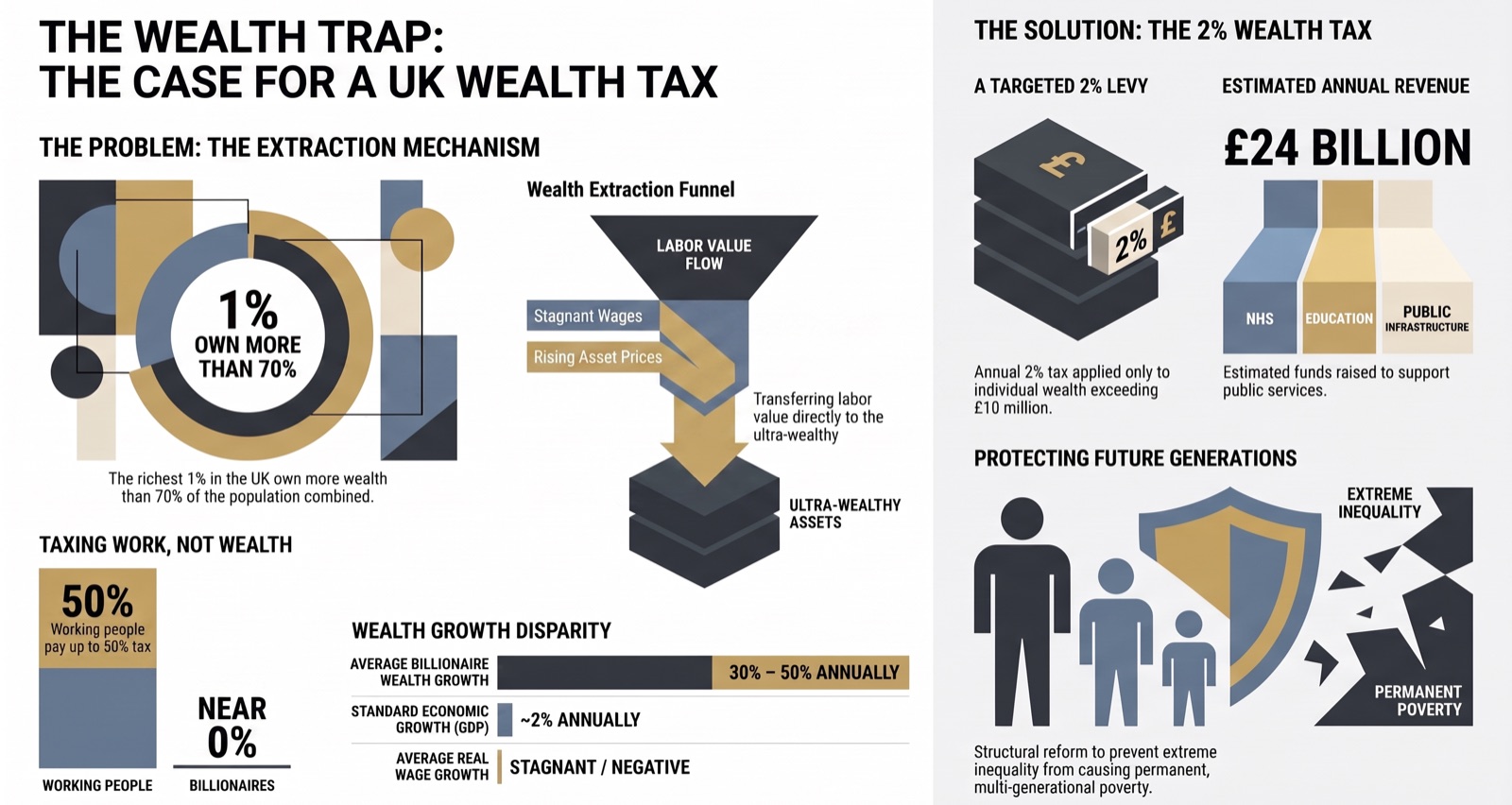
The UK tax system taxes labour income far more heavily than wealth. A worker earning above £50,270 pays 40% income tax plus 8% employee National Insurance on earnings above the threshold, giving a combined marginal rate of 48%. Add the employer's National Insurance contribution and the total wedge between what a worker costs an employer and what the worker takes home exceeds 50%.
By contrast, capital gains tax, which applies when an asset such as shares or a second property is sold at a profit, is charged at 18% or 24% for most assets after the October 2024 Budget, depending on the tax band. That is already a significantly lower rate than income tax. But the billionaire strategy goes further: by borrowing money against the value of their assets rather than selling them, the ultra-wealthy can access enormous spending power without ever realising a gain and without triggering any tax at all. Loans are not income; interest paid on private loans is a cost, not revenue.
The structural effect is stark. A doctor, teacher, or engineer pays tax on every pound they earn through work. A billionaire whose fortune grows by £30 million a year through rising asset values pays no tax on that growth until, and unless, they choose to sell. Many never do, passing assets to heirs instead, and inheritance tax can itself be substantially reduced through agricultural and business property reliefs.
Tax Justice UK and Patriotic Millionaires have proposed equalising capital gains tax rates with income tax rates, which they estimate would raise between £12 billion and £14.3 billion annually. The gap between those two rates is the measurable cost to the public of the current system's structural preference for wealth over work.
“I'm saying can we just stop this situation where working people pay 50% and billionaires pay 0%”— Gary Stevenson, Channel 4 News interview
Common questions
- Is it really legal to pay almost no tax by borrowing against assets?
- Yes. Borrowing against assets is entirely legal and widely practised by the ultra-wealthy. A loan is not taxable income. The strategy only fails if assets fall in value dramatically, which is rare for diversified portfolios of prime real estate and blue-chip shares.
- What is the current capital gains tax rate in the UK?
- Following the October 2024 Budget, capital gains tax on most assets was raised to 18% for basic-rate taxpayers and 24% for higher-rate taxpayers. This remains well below the 40% or 45% income tax rates paid on wages at the same wealth levels.
- Would equalising capital gains tax with income tax actually raise money?
- Tax Justice UK estimates it would raise between £12 billion and £14.3 billion per year. Critics argue some wealthy investors would restructure affairs to avoid the change, but research suggests the revenue impact would still be substantial.
Sources — check them yourself
- How to raise £60 billion for public services: ten tax reforms Tax Justice UK
- Debunking 5 common myths about wealth taxes Tax Justice UK
- Policy recommendations 2025 Patriotic Millionaires UK
- Income inequality in the UK House of Commons Library
- Wealth taxes Institute for Government