How many children in the UK are living in poverty, and are most of their parents actually working?
Around 4 million children (about 27%) were living in poverty in 2024/25 according to the Joseph Rowntree Foundation, and approximately 75% of them live in working households, meaning poverty is driven by low pay and high costs, not parental inactivity.
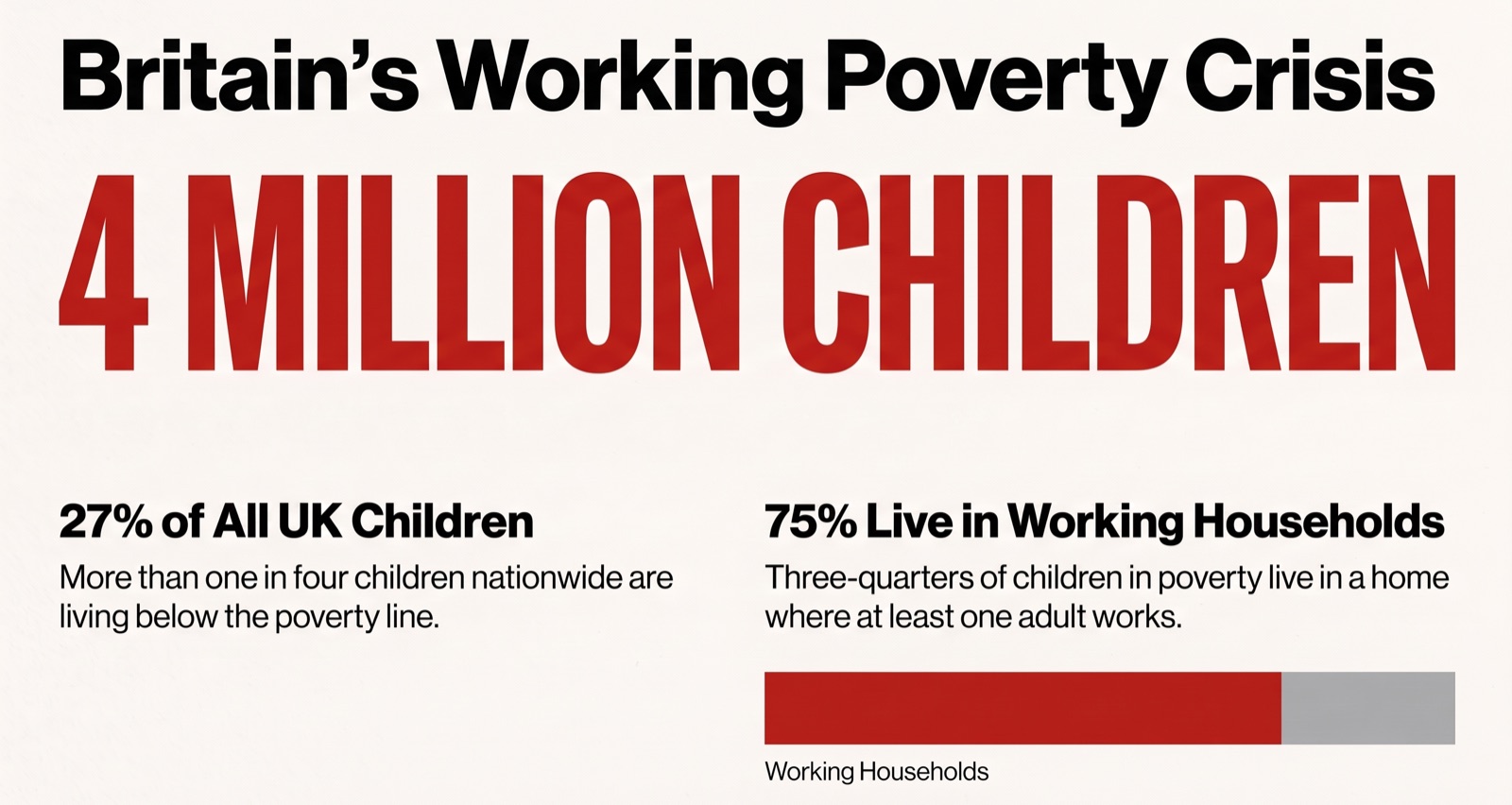
The Joseph Rowntree Foundation tracks child poverty across the UK each year using the standard measure of households living below 60% of median income. Their 2025 data shows approximately 4 million children, roughly one in four, below this line. The scale is not an outlier reading; it reflects a structural condition that has persisted for decades and worsened sharply during the cost-of-living crisis.
The most important and least understood fact about UK child poverty is that it is predominantly in-work poverty. Around 75% of children classed as poor live in a household where at least one adult has a job. The traditional idea that poverty is caused by idleness is not just morally questionable; it is factually wrong. Working for poverty wages while paying high rent is the dominant experience.
The picture is particularly severe in Scotland, where nearly one in four children lives in poverty despite legislative targets to reduce it. In Glasgow, approximately 33% of all children were living in poverty in 2022 to 2023. Within specific neighbourhoods, child poverty rates reach 75%. The Scottish Index of Multiple Deprivation records that nearly half of Glasgow's residents live in the 20% most deprived areas in Scotland.
The poverty rate is also deeply intersectional. More than half of all children in poverty live with a disabled household member. Nearly 47% of children in minority ethnic families are in poverty. Single-parent families are disproportionately affected, as are larger families penalised by the two-child benefit limit. These are not separate crises; they are all downstream consequences of a system that extracts wealth upward while leaving lower earners unable to cover basic costs.
“If you have billionaires growing their wealth at 30, 40, 50% in economies which are lucky if they grow 2%, how fast does cancer grow?”— Gary Stevenson, Channel 4 News interview
Common questions
- What counts as poverty in the UK?
- The standard measure is relative poverty: living in a household with income below 60% of the national median, measured after housing costs. This is the definition used by the Joseph Rowntree Foundation and the Child Poverty Action Group.
- If parents are working, why are their children still poor?
- Because wages have not kept pace with the rising cost of housing, food, and energy. A family paying half their take-home pay in rent has very little left for anything else, even with full-time employment.
- Is child poverty getting better or worse?
- The JRF's 2025 data shows child poverty remains persistently high. The cost-of-living crisis of 2022 to 2024 pushed more families into poverty, and the recovery in real wages has been slow for lower earners.
Sources — check them yourself
- Poverty in Scotland 2025 Joseph Rowntree Foundation
- New official data confirms child poverty is falling in Scotland CPAG
- Poverty and wealth overview Understanding Glasgow
- Child Poverty in Glasgow 2025 Centre for Civic Innovation
- Households Below Average Income: FYE 1995 to FYE 2025 DWP / GOV.UK