Did Gary Stevenson really make $35 million betting that inequality would break the economy?
Yes — the $35 million single-year profit figure was corroborated by former Citibank colleagues interviewed by the Financial Times. What they dispute is his claim to have been Citibank's most profitable trader in the world; the winning trade itself, a bet that inequality would keep interest rates near zero, is not in question.
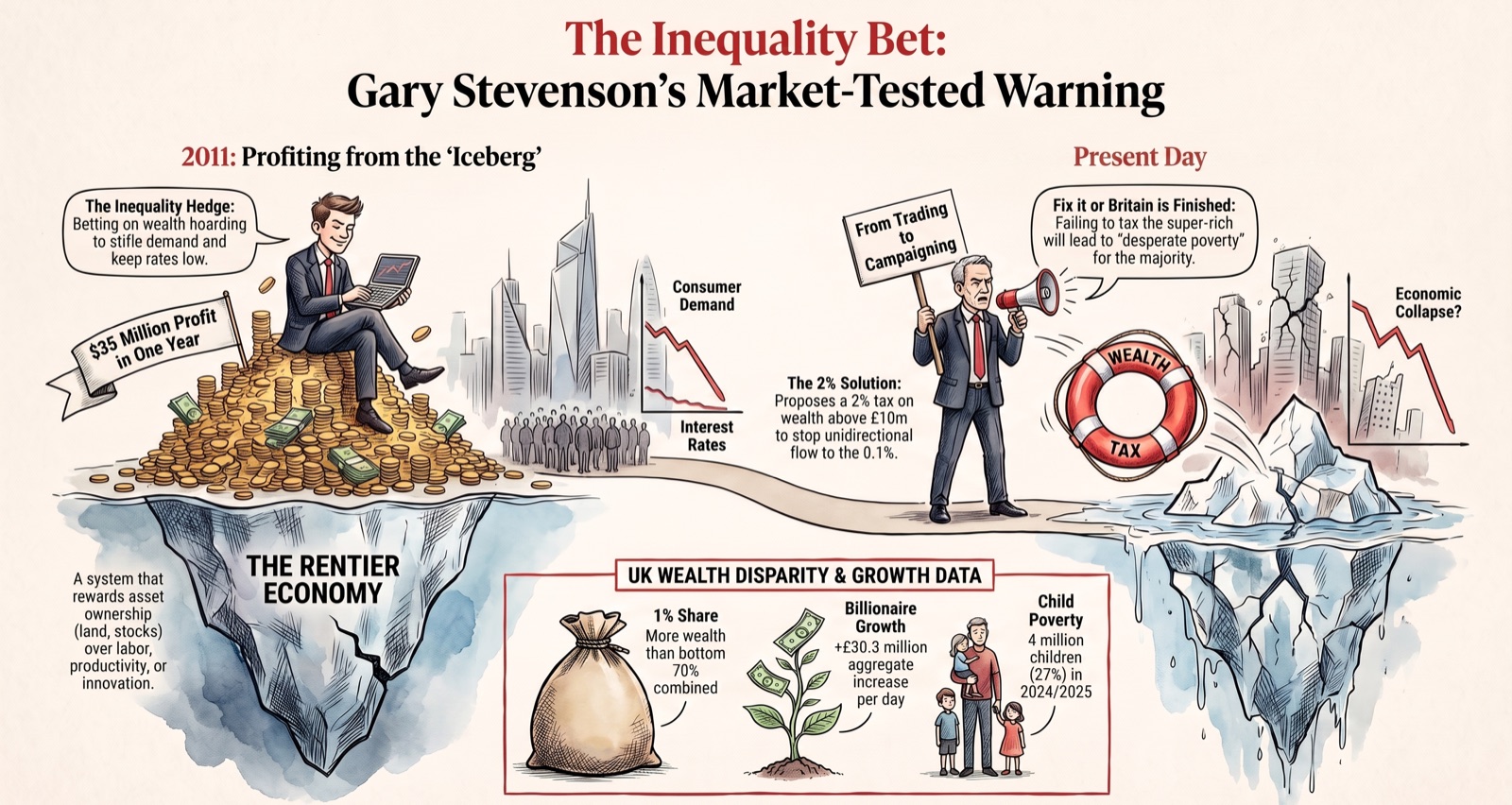
Gary Stevenson's economic warnings are often dismissed as ideology. His history says otherwise: as a young interest-rate trader at Citibank, his central bet was that wealth inequality was structurally destroying the spending power of ordinary households, that demand would therefore never recover, and that interest rates would stay pinned near zero long after mainstream forecasters expected them to rise. The market disagreed. He took the other side and won.
The scale of the win matters. In 2011, aged 24, Stevenson made a reported $35 million in profit for the bank in a single year. When the Financial Times investigated his story in late 2024, interviewing eight former colleagues from the trading floor, that profit figure was corroborated — even by people openly hostile to how he tells the rest of the story.
What the colleagues dispute is the title. Stevenson describes himself as Citibank's most profitable trader in the world that year; former colleagues told the FT the bank kept no such official global ranking, that traders in other asset classes made more in absolute terms, and that others on his own desk were internally rated more highly. This site takes no position on trading-floor bragging rights. The verifiable claims — the trade, the thesis behind it, and the eight-figure profit — stand.
Why does any of this belong on a fact site about wealth inequality? Because it is a rare case of the thesis being market-tested. Stevenson's argument — that inequality suppresses demand and drags growth and interest rates down with it — was not published in a pamphlet; it was priced, against professional opposition, with real money, and it paid. He then left the industry and now campaigns for the taxation of the wealth concentration he once profited from predicting.
“I'm a very good economist and I'm a very good trader, and I make correct predictions again and again because I'm right on one simple thing: you cannot allow inequality to rapidly grow in an accelerating fashion and not expect poverty.”— Gary Stevenson, Channel 4 News interview
Common questions
- Is the $35 million figure actually verified?
- The Financial Times interviewed eight of Stevenson's former Citibank colleagues in late 2024. The single-year profit figure was corroborated in that reporting; it is the 'best trader in the world' ranking that colleagues dispute.
- If his colleagues dispute his title, why believe anything he says?
- The dispute is about internal rankings that Citibank never officially published — trading-floor bravado on both sides. The checkable parts of the story, including the profit and the thesis behind the trade, survived a hostile investigation intact.
- What exactly was the trade?
- A bet, via interest-rate markets, that rates would stay near zero for years longer than the consensus expected — because wealth was concentrating so fast that ordinary households' spending power, and therefore demand and growth, could not recover.
- Why did he leave trading?
- He has said that profiting from an economy he believed was structurally failing became untenable, and he negotiated an exit from Citibank. He now campaigns full-time for wealth taxation through his channel GarysEconomics.
Sources — check them yourself
- Gary Stevenson claims to have been the best trader in the world. His old colleagues disagree Financial Times
- Gary Stevenson (campaigner) Wikipedia
- What happened when Gary Stevenson worked for Citi eFinancialCareers